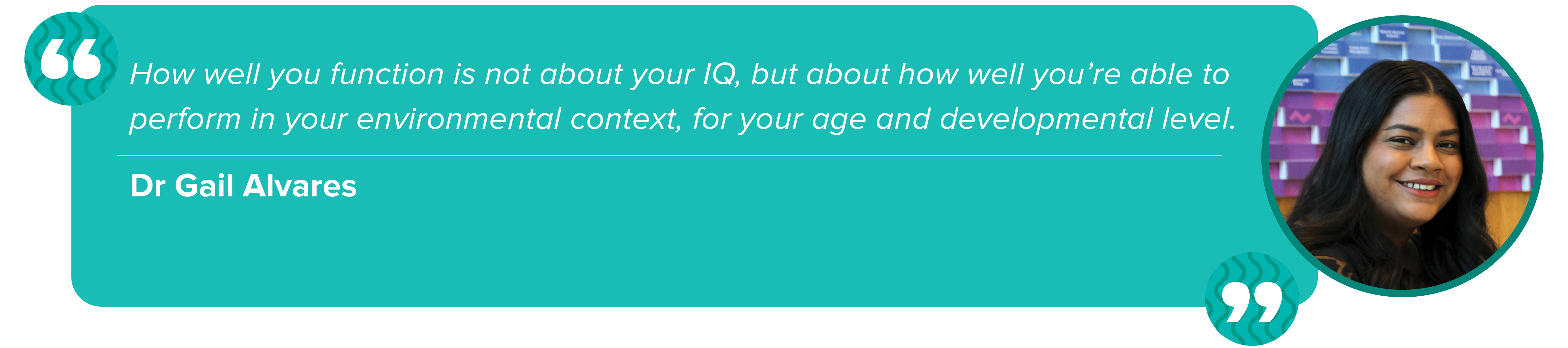
Dr Gail Alvares, of The Kids Research Institute Australia and The University of Western Australia.
Calls by The Kids researchers to abandon the inaccurate term ‘high functioning autism’ sparked a global conversation about how misleading and harmful the phrase can be.
The term ‘high functioning autism’ was coined by researchers in the 1980s as a way to describe people who had autism but did not have an intellectual disability.
Despite never having been an official clinical term, the descriptor soon entered the lexicon as a common way of describing people with autism who had an average or higher than average IQ; and came to imply that even though the person might have autism, since they had a relatively high IQ they could nevertheless manage their everyday lives without trouble.
To many frustrated advocates and families of people with autism, this couldn’t have been further from the truth: their daily experience frequently amounted to quite the opposite. Nevertheless, the misnomer persisted.
Now, research led by Dr Gail Alvares, from The Kids’ CliniKids team, may finally help lay the term to rest. In a study published in June 2019, Dr Alvares demonstrated that children on the autism spectrum who would typically have been deemed ‘high functioning’ due to their IQ level – or lack of intellectual disability – did not have a correspondingly high level of functional ability.
Many actually had quite poor day-to-day functioning skills, struggling with everyday tasks like understanding instructions, note-taking, self-care, changes to routine, or interacting with others.
The study argued the term ‘high functioning’ was not only inaccurate but could be harmful, with children unfairly expected to function at a higher level than they were capable of. This unrealistic expectation could lead others to minimise or overlook their challenges in completing everyday tasks, and even see a child denied appropriate support.
“The term ‘high functioning autism’ is not a diagnostic term and is based on an IQ estimate, rather than a functional assessment,” Dr Alvares said.
“Many children and young people with autism may have an IQ in the typical range for their age but still struggle with skills like getting themselves to school, navigating public transport, or communicating at the same level as their peers.