
Search
Research
A general factor for trust?: Testing latent factor structures of trust across institutional and interpersonal contextsThe literature is replete with multi-dimensional self-report assessments of trust. It is not clear whether these dimensions are statistically distinguishable across institutional and interpersonal contexts, respectively.
Research
A Scoping Review of Methodologies Exploring Diet and Health Outcomes in Lactating Women: What Has Been Done and Where to Next?Developing dietary guidelines for lactating women presents significant challenges, due to limited evidence being available on their specific nutrient needs and the biological impacts of various dietary dimensions. Current dietary recommendations often rely on data from nonlactating women, leading to potential inaccuracies.
Research
Oombarl Oombarl Joorrinygor-Slowly Slowly Moving Forward: Reflections From a Cross-Cultural Team Working Together on the See, Treat, Prevent (SToP) Trial in the Kimberley Region of WAReflexivity is crucial for researchers and health professionals working within Aboriginal health. Reflexivity provides a tool for non-Aboriginal researchers to contribute to the broader intention of reframing historical academic positivist paradigms into Indigenous research methodologies to privilege Aboriginal voices in knowledge construction and decision-making.
News & Events
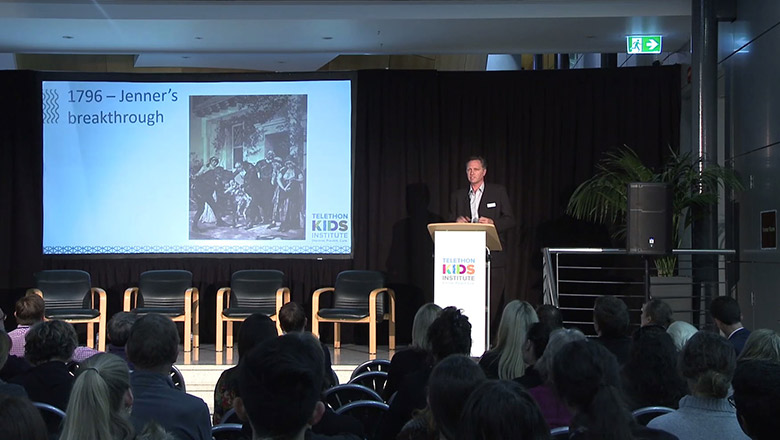
Vaccination seminar presentationsOn Monday May 30, The Kids Research Institute Australia held a free public seminar on vaccination, hearing from paediatricians and infectious disease researchers.
Research
Ancestral SARS-CoV-2, but not Omicron, replicates less efficiently in primary pediatric nasal epithelial cellsChildren typically experience more mild symptoms of Coronavirus Disease 2019 (COVID-19) when compared to adults. There is a strong body of evidence that children are also less susceptible to Severe Acute Respiratory Syndrome Coronavirus 2 (SARS-CoV-2) infection with the ancestral viral isolate.
Research
How does the school built environment impact students’ bullying behaviour? A scoping reviewSchool bullying is a public health concern affecting the physical and mental health of children and young people. While school-based interventions to prevent bullying have been developed internationally, the effectiveness of many interventions has been mixed and modest.
Research
Pre-and Postnatal Vitamin D Status and Allergy Outcomes in Early ChildhoodThe dramatic increase in the prevalence of allergic disease in recent decades reflects environmental and behavioural changes that have altered patterns of early immune development. The very early onset of allergic diseases points to the specific vulnerability of the developing immune system to environmental changes and the development of primary intervention strategies is crucial to address this unparalleled burden.
Research
Toxicity of different biodiesel exhausts in primary human airway epithelial cells grown at air-liquid interfaceBiodiesel is created through the transesterification of fats/oils and its usage is increasing worldwide as global warming concerns increase. Biodiesel fuel properties change depending on the feedstock used to create it.
Research
A pilot study of disease related education and psychotherapeutic support for unresolved grief in parents of children with CFDiagnosis of chronic disease in a child can result in unresolved grief (UG) in parents. This study aimed to evaluate the efficacy of psychological insight-oriented therapy (IOT) as a treatment for UG compared to disease related education in parents of children with cystic fibrosis. Sequence of delivery, first IOT then disease related education (or vice versa) was also examined, to let all participants experience both interventions.
Research
Penicillin allergy SHACK: Survey of hospital and community knowledgePenicillin allergy accounts for the majority of all reported adverse drug reactions in adults and children. Foregoing first-line antibiotic therapy due to penicillin allergy label is associated with an increased prevalence of infections by resistant organisms and longer hospitalisation.