
Search
Showing results for "grants"
News & Events
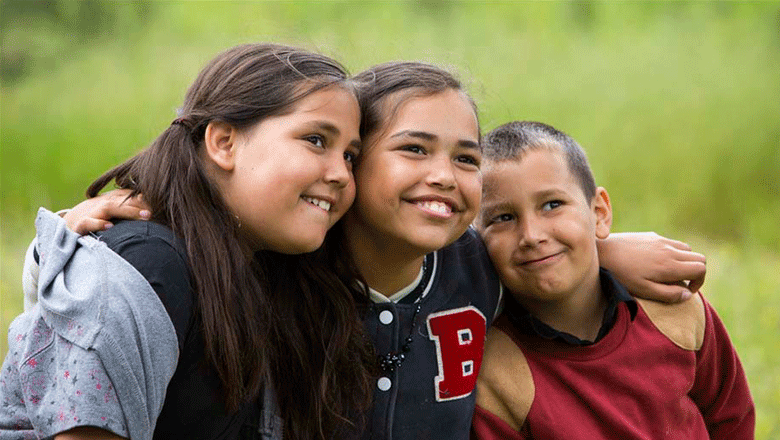
Aboriginal researchers achieve milestoneThe first Capacity Building Grant comprising solely of Indigenous researchers has been completed successfully
News & Events
Exposure to sunlight could reduce asthmaAustralian researchers have found that exposure to measured doses of ultraviolet light, such as sunlight, could reduce asthma.
News & Events
Supply partnership with Aboriginal businesses to help close the gapThe Kids Research Institute Australia is pleased to announce its membership of Supply Nation, a leader in supplier diversity that works to connect Australian companies
Research
Autistic and autism community perspectives on infant and family support in the first two years of life: Findings from a community consultation surveyMost support programmes for Autistic children are available only after they are diagnosed. Research suggests that parenting supports may be helpful for parents and their infants, when provided in the first 2 years of life - before a formal diagnosis is given, but when information suggests an infant is more likely to be Autistic. However, we do not know how acceptable these types of supports might be to the Autistic and autism communities.
Research
Shoulder dystocia in babies born to Aboriginal mothers with diabetes: a population-based cohort study, 1998–2015Australian Aboriginal and Torres Strait Islander women with diabetes in pregnancy (DIP) are more likely to have glycaemic levels above the target range, and their babies are thus at higher risk of excessive fetal growth. Shoulder dystocia, defined by failure of spontaneous birth of fetal shoulder after birth of the head requiring obstetric maneuvers, is an obstetric emergency that is strongly associated with DIP and fetal size.
Research
Chronic suppurative otitis mediaChronic suppurative otitis media (CSOM) is a leading global cause of potentially preventable hearing loss in children and adults, associated with socioeconomic deprivation. There is an absence of consensus on the definition of CSOM, which complicates efforts for prevention, treatment, and monitoring.
Research
Parent-Child Interactions May Help to Explain Relations Between Parent Characteristics and Clinically Observed Child Autistic BehavioursThe importance of supporting parent-child interactions has been noted in the context of prodromal autism, but little consideration has been given to the possible contributing role of parental characteristics, such as psychological distress. This cross-sectional study tested models in which parent-child interaction variables mediated relations between parent characteristics and child autistic behaviour in a sample of families whose infant demonstrated early signs of autism.
Research
Early detection of hearing loss for infants in Western Australia: Comparison to international benchmarksTo assess the degree to which timely audiological assessment of congenital hearing loss is achieved at our institution - Perth Children's Hospital, Western Australia, and to review cases which breached this timeframe in order to address barriers to timely assessment. The benchmark used to determine timely assessment is that set out by The Joint Committee on Infant Hearing (JCIH) in which diagnostic audiological testing occurs by three months of age for those who do not pass newborn hearing screening.
Research
Autism-related dietary preferences mediate autism-gut microbiome associationsThere is increasing interest in the potential contribution of the gut microbiome to autism spectrum disorder (ASD). However, previous studies have been underpowered and have not been designed to address potential confounding factors in a comprehensive way.
Research
Overweight/obesity and other predictors of gestational diabetes among Aboriginal and non-Aboriginal women in Western AustraliaThis population-based study investigated the association of BMI and other predictors with gestational diabetes mellitus among Australian Aboriginal and non-Aboriginal mothers. We conducted a state-wide retrospective cohort study that included all singleton births in Western Australia between 2012 and 2015 using population health datasets linked by the Western Australian Data Linkage Branch.