
Search
Showing results for "Professor"
Research
Otitis media at 6-monthly assessments of Australian First Nations children between ages 12–36 months: Findings from two randomised controlled trials of combined pneumococcal conjugate vaccinesIn remote communities of northern Australia, First Nations children with hearing loss are disproportionately at risk of poor school readiness and performance compared to their peers with no hearing loss. The aim of this trial is to prevent early childhood persisting otitis media (OM), associated hearing loss and developmental delay.
Research
Does cerebral lateralization develop? A study using functional transcranial Doppler ultrasound assessingIn the majority of people, language production is lateralized to the left cerebral hemisphere and visuospatial skills to the right.
Research
Where were those rabbits? A new paradigm to determine cerebral lateralisation of visuospatial memory function in childrenIn the majority of people, functional differences are observed between the two cerebral hemispheres: language production is typically subserved by the left...
News & Events
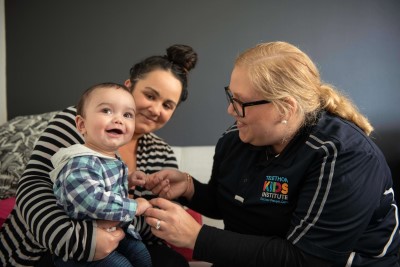
Perth’s Aboriginal babies show first signs of ear disease at just eight weeksThe Kids Research Institute Australia researchers have found close to 40 per cent of Aboriginal babies begin to develop middle ear infections between two and four months of age in a first of its kind study in metropolitan Perth.

News & Events
Key study unveils significant link between hospital admissions and kids with ADHDNew research from The Kids Research Institute Australia has revealed a significant link between kids with severe ADHD and higher rates of early childhood hospital admissions.
News & Events
Alarming increase in drug affected newbornsA new Australian study has found that the number of newborns suffering serious drug withdrawal symptoms is now more than 40 times higher than in 1980.
Research
Investigating Parental Observations of Early Autism Development in Simplex and Multiplex FamiliesPast research has highlighted the importance of early identification of developmental differences to improve targeted access to early interventions or supports. As such, it is of particular importance in the context of children at elevated likelihood of autism (such as where an older sibling has a diagnosis of autism), to better understand when and which early concerns are important as predictors of which children will benefit from pre-diagnostic supports.
Research
Remote paediatric ear examination comparing video-otoscopy and still otoscopy clinician rated outcomesTelemedicine, particularly real time video-otoscopy in rural and remote Australia holds great potential in assessing and managing otology conditions. There is good evidence of store and forward images for assessment, however limited evidence exists for the use of real-time video-otoscopy. The objective of this study was to assess the validity of using real time video-otoscopy, compared to standard store and forward still image otoscopy, in a paediatric population.
Research
Identifying SETBP1 haploinsufficiency molecular pathways to improve patient diagnosis using induced pluripotent stem cells and neural disease modellingSETBP1 Haploinsufficiency Disorder (SETBD) is characterised by mild to moderate intellectual disability, speech and language impairment, mild motor developmental delay, behavioural issues, hypotonia, mild facial dysmorphisms, and vision impairment. Despite a clear link between SETBP1 mutations and neurodevelopmental disorders the precise role of SETBP1 in neural development remains elusive.
Research
The use of tranexamic acid in paediatric adenotonsillectomy – A systematic review and meta-analysisTonsillectomy and adenoidectomy are two of the most commonly performed ENT procedures in children, with over 500,000 cases performed annually in the United States. Whilst generally considered a safe and well-tolerated operation, it is not without its risks and complications including pain, nausea, anorexia and most importantly bleeding and post-tonsillectomy haemorrhage.