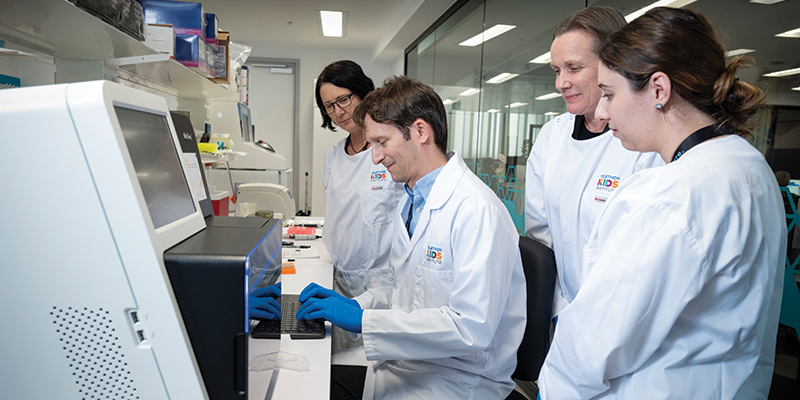
Dr Timo Lassmann and team
The Kids Research Institute Australia researchers are at the forefront of rapid improvements in the diagnosis of rare diseases, with the Institute’s Genetics and Rare Disease program using powerful new tools to decipher conditions that until now have defied understanding.
Just six years ago, researchers – including rare diseases expert Professor Gareth Baynam and computational scientist Timo Lassmann – were far less confident about diagnosing with certainty a child presenting with a complex array of severe and unusual symptoms.
But within a very short period, those odds have dramatically risen.
“If you’d come to me in 2013 and asked, what are the chances of a child with a combination of severe and unusual characteristics having a confirmed diagnosis, I’d have said nine per cent.
In 15 months it went to 30 per cent – tripling.
“Then we created the Undiagnosed Disease Program and took the diagnostic rate from 30 per cent to 55 per cent – all in a few years,” Professor Baynam said.
Professor Baynam, Clinical Geneticist and an Honorary Research Fellow at The Kids, said rapid improvements in the diagnosis of rare diseases were set to continue globally, with the Institute at the forefront of that wave.
Professor Baynam works with the Institute’s Genetic and Rare Diseases Program – a critical part of the Undiagnosed Disease Program, which brings together a multidisciplinary team of clinicians and a team of computational scientists led by Dr Lassmann, who are pursuing a unique approach that treats every patient as an individual.
Dr Lassmann said that instead of treating each child as a ‘blank canvas’, the researchers undertook a targeted analysis of each patient’s information, using medical indicators the clinical team had identified.
“The main activity here is phenotyping: very accurate descriptions of what’s wrong with the child,” Dr Lassmann said.
“We use that information as a starting point to look for disease genes that we know to be associated with those phenotypes. We then apply large genomics data and build predictor models that interrogate that patient’s genome in a way that’s guided by the phenotype.
“The difference, on the computation side, is that other approaches treat all the patients the same, using one machine-learning method to find disease-causing variants. What we do is build machine-learning algorithms for each patient.
“I call this ‘personalised analytics’. It’s a new thing we do – build an entire analysis pipeline around what’s wrong with that particular child – and it seems to be better than treating everyone the same.”
“As we go forward we want to merge this as much as possible, to make use of all the information we have, whether it’s genomics, transcriptomics or something a clinician noticed.”
Recently, Professor Baynam and Dr Lassmann collaborated with international colleagues to write a commentary published in the journal Cell, discussing technological advances in the field that will help in the future.
Both said it was an important article, shining a light on rare disease diagnosis in a high impact way to help galvanise researchers worldwide around a common mission.
The article’s authors, including Professor Baynam and Dr Lassmann, are part of an international taskforce formed to help advance diagnosis for children with unsolved medical mystery conditions. The taskforce is part of the International Rare Diseases Research Consortium – a global collaborative founded in 2011 which aims, by 2027, to create the means to diagnose all people living with a rare disease within one year of coming to medical attention.
“The goal is deliberately ambitious, but so too have been previous targets – and they have been exceeded ahead of time,” Professor Baynam said
What's next
-
Incorporating 3D facial analysis approaches together with CliniFace – combining the faces and voices of children and families to unlock answers for children with rare disorders and improve their health.
-
Increasing health equity and cultural safety through partnering with the voice (language) of Aboriginal children and families, via the UNESCO-endorsed Life Languages initiative – part of the United Nations Year of Indigenous Languages.

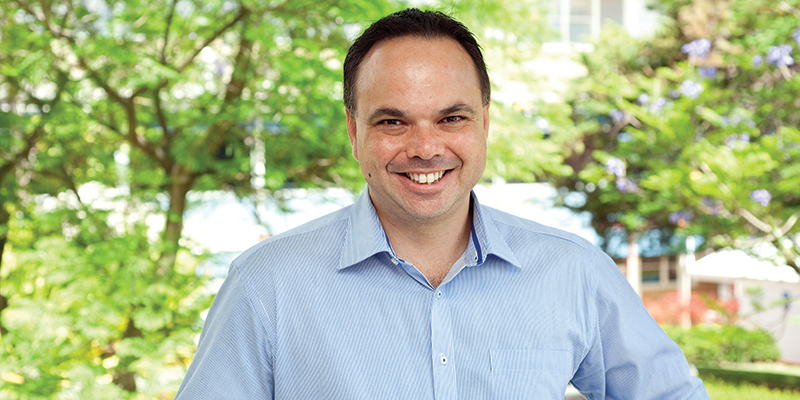 Professor Gareth Baynam