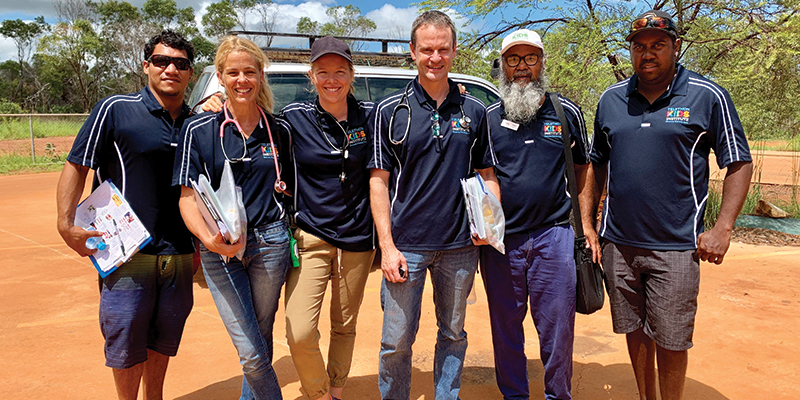
From left: Community researcher David Ougham, Pam Laird, physiotherapist and co-researcher Annie Scanlon, André Schultz, John Jacky (Telethon Kids Kimberley), and community researcher Craig Sampi, at Djarindjin in the Dampier Peninsular
Paediatric lung health researcher Pam Laird has decades of clinical experience but says her experience working towards improved early diagnosis of chronic wet cough and lung disease in Kimberley Aboriginal children has changed her world view – particularly around the importance of grass roots community collaboration.
Prevalence of chronic lung disease in Aboriginal children is conservatively estimated at 1.5 per cent. A wet cough, which is caused by mucus in the airways, often indicates low grade bacterial infection if the cough is present for more than four weeks. Such an infection can lead to permanent lung damage.
“Chronic wet cough can lead to really serious health issues, but it’s often curable – if we find it and manage it early,” Ms Laird said.
“What we were finding during our visits to the Kimberley is children in Aboriginal communities were often presenting to doctors far too late, when they’d had their wet cough for a long time and already had lung damage, which could have been prevented if they’d been treated earlier.”
She said culturally appropriate early management was key, but to achieve that, researchers had to work in partnership with communities.
“As researchers, we can’t go into these communities with a paternalistic Western model of medicine and think we can fix the problem,” Ms Laird said.
“You’ve got to establish relationships with the community first and find out what their understanding is, what they need and what is already working well. Then, together we can find solutions to providing health care in a way that’s culturally meaningful and sustainable.”
With the help of staff at Telethon Kids Kimberley, Ms Laird and Telethon Kids paediatric lung health researcher Dr André Schultz worked with 40 families as well as local health service providers – including the Kimberley Aboriginal Medical Services (KAMS), Broome Regional Aboriginal Medical Service (BRAMS), and WA Country Health Service – to come up with a strategy to raise awareness and improve recognition and management of chronic wet cough and lung disease.
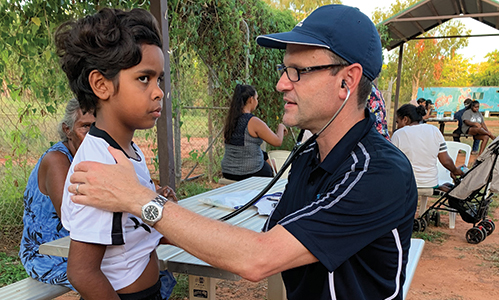
They took a two-pronged approach, speaking at length with families to gauge what they understood about wet cough and lung health; and interviewing health practitioners to find out what they knew about these problems and what they saw as the barriers to managing affected children.
“We found that wet cough in children is normalised, both within the medical profession and families,” Ms Laird said.
“Knowledge about chronic wet cough in children is not widespread in the medical profession, since it was only formally recognised in 2006 that chronic wet cough in the absence of other signs or symptoms could represent serious disease.
“Health practitioners haven’t really had it on their radar as a public health issue before now, so haven’t been screening for it, and families haven’t known that a chronic wet cough could be such a big issue.”
“Families told us they’d never ever received any information like this before. They said ‘If you’d told us, we would have gone and got help for the kids’.”
Using this information, the researchers shaped a comprehensive implementation strategy which they tested for effectiveness in the Kimberley. The strategy centred around a health information campaign enlisting West Coast Eagles rookie and Balgo boy, Francis Watson, as a cultural ambassador to feature in radio, television, social media and print advertisements as well as community appearances and talks. The team also produced a culturally relevant flip chart about lung health and a short animation featured on YouTube.
The materials and advertisements, along with workshops and training sessions for local health practitioners, were pushed out during a three-month campaign late 2018, targeted at Aboriginal communities and health services around the Broome area.
“It was an amazing community effort on a shoestring budget, but the results have been really positive,” Ms Laird said.
Although the team is still measuring the outcomes, anecdotally doctors are already reporting an increase in the number of children presenting and being treated, and families are telling Ms Laird stories of children who had been unwell for years, receiving treatment and experiencing vastly improved health.
“It’s so much bigger than the research,” Ms Laird said. “It’s all the knock-on effects. Little lungs are being made healthy as we go – if we find children with lung sickness, we are able to tell families to present to their local clinic for help. And because we’re doing the project in collaboration with the local medical clinics, they have the skills to manage the children. Families are also getting valuable information about healthy lungs and what warning signs to look out for in the future.
“The benefits have been amazing. Families are empowered with health information so they can advocate for their children’s lung health, medical practitioners are being trained in early management of lung disease, local Aboriginal people are being trained in research skills, and we as Telethon Kids researchers are learning directly from local Aboriginal people about how to do things the local way.
“It’s a game changer for us and I have come to see that the only way forward is walking and learning together.”
“It’s really reiterated that the medicine is only going to get you so far: if you don’t have trust and relationships with families, you are never going to get anywhere in the long term.”
What's next
-
Results of a world first-study measuring prevalence of chronic wet cough and protracted bacterial bronchitis (bacterial infection of the mucus in the lower airways or lungs) in four Kimberley Aboriginal communities will soon be published. Preliminary results suggest prevalence of chronic wet cough could be greater than 10 per cent in the Kimberley.
-
The researchers will complete their formal evaluation of the wet cough campaign and its impact on practitioners and communities.
-
The team plans to develop the state’s first teaching models for medical staff to provide culturally appropriate management of chronic lung disease in Aboriginal children.